Volume 3 Issue 1
Estimation of critical period of weed control in mulberry cultivation by application of calibration problem extended to non-linear models
Author(s): A. MAJUMDER, C.K. KUNDU, R. NATH, P.S. BERA* AND SK. J. ISLAM
Abstract: Calibration problem is normally used for estimation of an unknown value of an independent variable (X) corresponding to an
observed value of a dependent variable (Y) which is functionally related to X. This paper is concerned with the development of a
confidence interval (C.I.) for an unknown value of X corresponding to a specified or predetermined value of Y, where the
relationship between X and Y may be linear or non-linear. The problem of weeds in mulberry cultivation is severe. The produce
of mulberry cultivation is the leaf which is entirely dependent on the physiological condition of the plant. If weeds or unwanted
plants make any disturbance to the mulberry plants, the leaf production declines, directly. The control of weeds in proper time in
mulberry cultivation, therefore, is vital. In the presentation piece of investigation, an attempt has been made to estimate the
critical period of weed control (CPWC) in mulberry cultivation. We apply calibration techniques to linear and non-linear models
to estimate the best period for weed control for, at least, 90% of leaf production for four different seasons (viz., August, 1992 to
November,1992; November,1992 to March,1993; April, 1993 to June, 1993 and August 1993 to November, 1993.
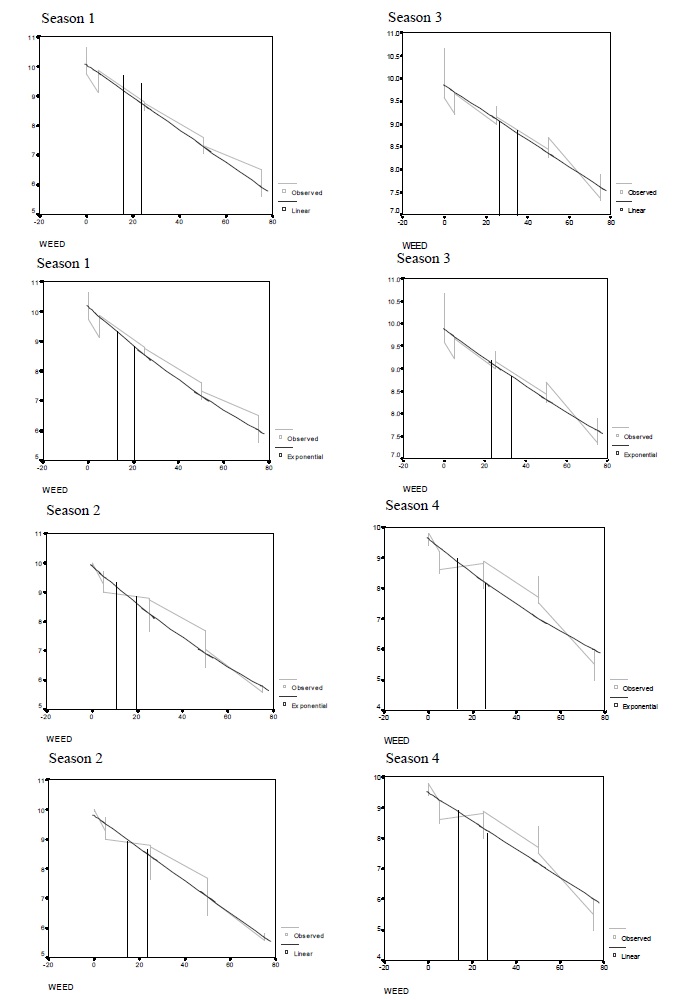
Fig: Estimation of critical period of weed control in mulberry cultivation by application of calibration problem extended to non-linear models
Download Full Article : Click Here
