Volume 6 Issue 1
Current status of herbicide resistant weeds around the Globe
Author(s): P. C. BHOWMIK
Abstract: The incidence and wide spread of herbicide resistant weeds is a globalproblem. Over the past 65 years, repeated use of
herbicides has resulted in the evolution of resistant weed species. The first resistant species to triazine was discovered in
1970 in the United States. Since then, a large number of weed species has evolved resistance to several classes of herbicide.
Currently, there are 334 resistant biotypes, including 190 weed species (113 dicots and 77 monocots) in over 310, 000 fields
around the world. Common resistant species are Chenopodium album and Amaranthus retrojlexus resistant to triazine,
Phalaris minor resistant to isoproturon, P. minor and P. paradoxa resistant to diclofop, Echinochloa colona resistant to
propanil, Echinochloa crusgalli resistant to butachlor, Eleusine indica resistant to trifluralin, lolium rigidum resistant to
diclofop, Lactuca serriola resistant to metsulfaron, glyphosate resistance to Eleusine indica, Conyza canadensis, Lolium
rigidum, and lolium multiflorum. Multiple weed resistance to more than one class of herbicides with different modes of
action has also been documented with many species. Currently there has been increased herbicide resistance to various
weed species around the globe. Most common species are Lolium rigidum, Avena fatua, Amaranthus retroflexus,
Chenopodium album, Setaria viridis, Echinochloa crusgalli, Eleusine indica, Kochia scoparia, Conyza canadensis, and
Amaranthus hybridus.
For Related Figures: Click Here
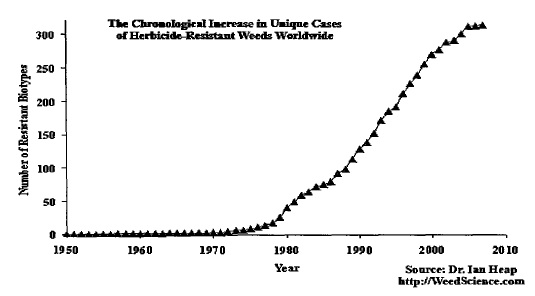
Fig 1: The chronological increase in unique cases of herbicide-resistant weeds worldwide
Download Full Article : Click Here
