Volume 6 Issue 1
Long term herbicide usage on weed shift and productivity in transplanted
finger millet - groundnut cropping system in southern Karnataka
Author(s): T.V. RAMACHANDRA PRASAD, V.K. KIRAN KUMAR, G.R. DENESH AND M.T. SANJAY
Abstract: A field experiment was initiated during Kharif, 1999 with finger millet as first crop followed by groundnut in
summer season at the Main Research Station, Hebbal, Bengaluru to know the long term effect of herbicide usage in the same
piece of land on weed shift and yield of crops during 1999 to 2008. The pooled data of nine finger millet crops from 1999 to
2007 Kharif indicated that application of butachlor at 0. 75 kg ai/ha more or less gave similar grain yield (3533 kg/ha) to
hand weeding twice (3395 kg/ha), due to good control of weeds. Similarly over nine groundnut crops, pod yield obtained in
plots applied with pendimethalin at 1.0 kg ai/ha (2160 kg/ha) was similar to hand weeding twice (2094 kg/ha). Continuous
application of alachlor 1.0 kg ai/ha in groundnut and 2,4-D EE 0.75 kg ai/ha infinger millet paved way for dominance of
grasses particularly Digitaria marginata, Dactyloctenium aegyptium and Echinochloa colona, while use of pendimethalin
treated plot showed higher emergence of Commelina benghalensis. Further plot applied with FYM +fertilizer gave slightly
higher yield as compared to plot applied with fertilizer alone in groundnut - finger millet cropping system. A saving of
weeding cost to an extent of Rs. 6810 to 6980/ha in finger millet and Rs. 3018 to 3910/ha was observed in groundnut by
using herbicides as compared to hand weeding. None of the herbicides affected the establishment, growth and yield of
succeeding crops over past nine years, in spite of herbicides being applied continuously on the same piece of land.
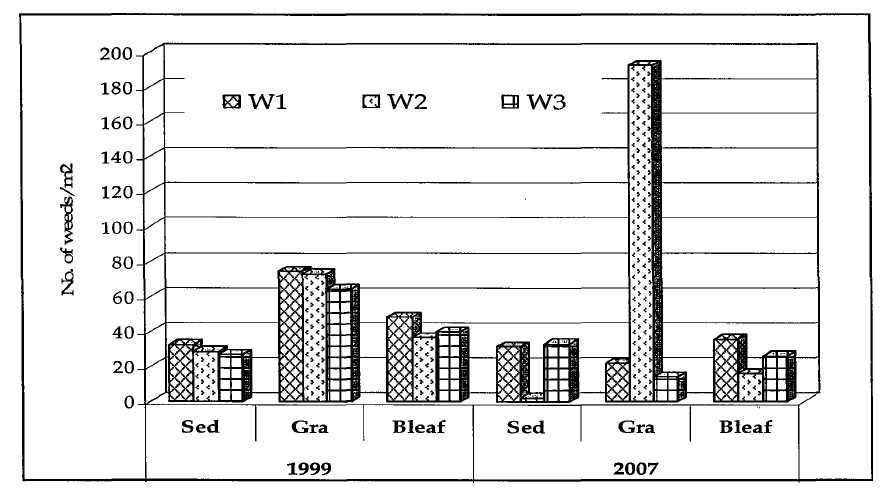
Fig: Shift in weed flora due to continuous use of weed management practices in transplanted finger millet.
Download Full Article : Click Here
